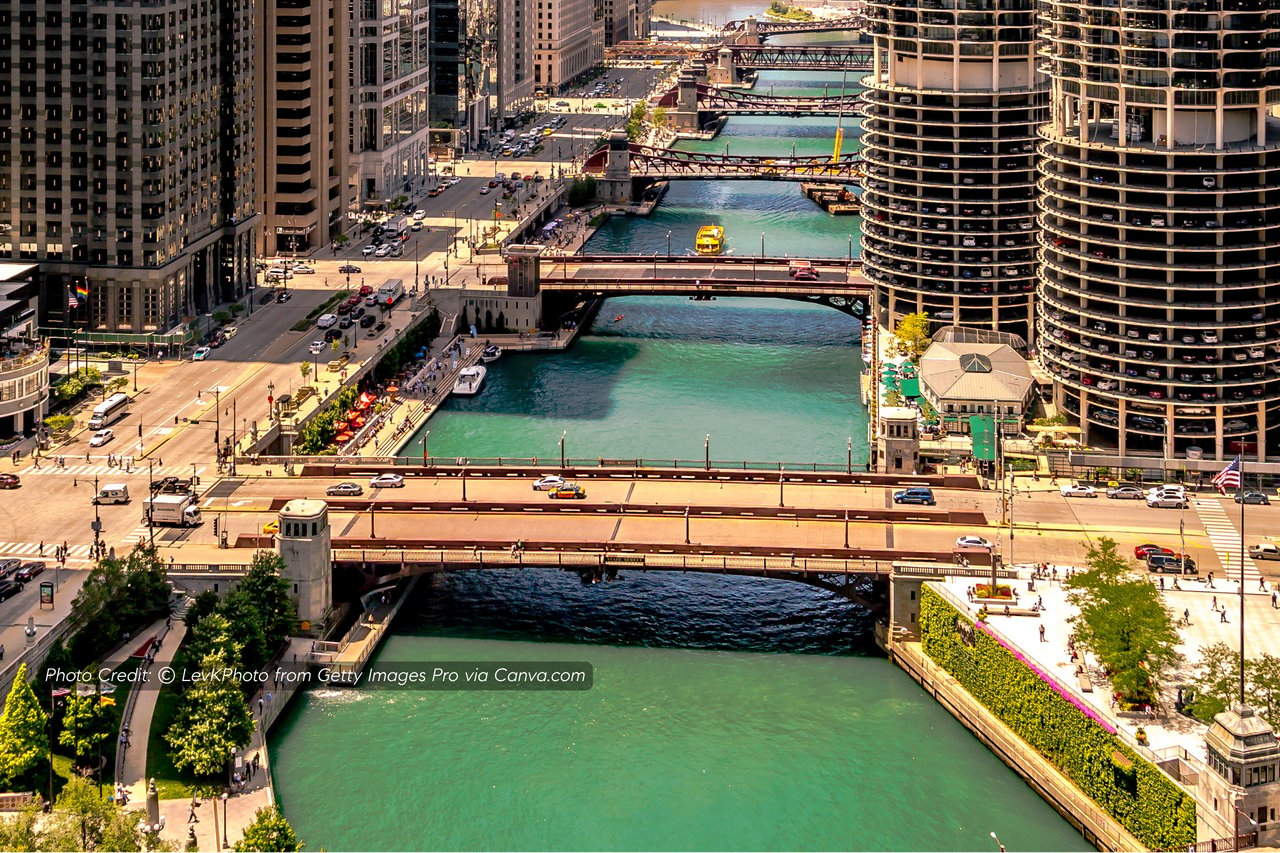
Most buyers who tell me they want to live "in the Loop" are describing a feeling more than a location. They picture the skyline, the walk to the office, the river at golden hour. What they haven't yet done is draw the line, and in the Loop, the line is water.
The Chicago River wraps the Loop on two sides. The main stem runs along its northern edge, and the South Branch runs down its west. Those two edges are crossed by a dense run of movable bridges. Chicago holds 37 movable bridges within the city, per the Chicago Architecture Center, and 18 of them run through the downtown river corridor between Lake Shore Drive and Van Buren Street. Most buyers experience those bridges as scenery. After enough years working this market, I read them as boundaries. Where you sit relative to the river, and to the specific bridge you cross to get home, quietly shapes what you pay and how the property holds its value.
I call it the two-bridge rule. Pick your bridge before you pick your building.
Key Takeaways
The Chicago River borders the Loop on two sides and is crossed by 18 movable bridges in the downtown corridor between Lake Shore Drive and Van Buren Street, out of 37 in the city per the Chicago Architecture Center, creating hard geographic edges that price differently block by block.
The main stem separates the Loop from the Near North Side; the South Branch separates it from the Near West Side. Cross either one and the buyer pool, the product type, and the price logic change with it.
The Loop's residential base is now the fastest-growing in the city over recent decades, per U.S. Census data, with roughly 4,000 new residential units and $1.67 billion in investment tied to planned downtown conversions, per the Chicago Department of Planning and Development. Scarcity of anything other than condos is the defining supply story.
Protected river and lake sightlines, which cannot be built out, carry a durable premium that a comparable interior-facing unit does not.
The scarce single-family and boutique luxury product near the river's edges behaves differently from the Loop's deep condo inventory, and that distinction is where long-term value tends to concentrate.
The River Is Not Scenery. It's a Property Line.
Every serious city has a feature that organizes its prices. In Chicago's core, it's the river, and there's a single point that proves it. At Wolf Point, where the North, South, and main branches meet just west of the Merchandise Mart, three of the city's community areas physically touch: the Loop, the Near North Side, and the Near West Side. That confluence is so central to the city's identity that its Y-shape became Chicago's municipal device, the symbol you'll spot carved into buildings all over downtown. A buyer standing near Wacker Drive is often three minutes and one bridge from a completely different pricing conversation, and at Wolf Point, from a different neighborhood entirely.
Here is what makes Chicago unusual. The river isn't a static edge. Those downtown bridges are working bascule spans that lift for boat traffic in season, and citywide the bridges are raised roughly 30,000 times a year, per Loop Chicago. A residence facing an active bridge lift gets a view most cities can't offer. It can also get intermittent noise and traffic pauses that a buyer three floors up and one street back never notices. Neither is inherently better. But they are different products at different prices, and the difference is often measured in exactly which bridge sits outside the window.
The North Edge: Where the Loop Meets the Near North Side
Cross the main stem heading north, over the DuSable Bridge at Michigan Avenue or the Wells Street bridge, and you leave the Loop's office-dominated grid for the Near North Side's residential density. The pricing character changes with it.
The Loop's own housing stock is heavily weighted toward condos, many office-adjacent, valued for proximity above all. Its residential population has grown faster than any other Chicago community area in percentage terms since 1950, per U.S. Census data, but that growth has arrived almost entirely as high-rise condos and apartments, not houses. Step across the river into the Near North Side, which Walk Score ranks among the most walkable neighborhoods in the city, and the buyer pool shifts toward people optimizing for lifestyle and lake access rather than a zero-minute commute. The blocks nearest the river on the north bank, with protected water views and the Riverwalk at street level, tend to command a premium the interior Loop, hemmed in by towers, structurally cannot match. What I tell buyers is simple: the last row of buildings before the water is a different asset class than the row behind it, even when they share a zip code.
The West Edge: Where the Loop Meets the Near West Side
The South Branch does the same work on the Loop's western flank. Cross at Adams, Monroe, or Madison and you move toward the Near West Side and, beyond it, the Fulton Market corridor that has reshaped this side of downtown.
That western river edge is where I watch the price-to-value gap most closely. Fulton Market holds the lowest office vacancy in the entire Chicago central business district at 18.9%, per Cushman & Wakefield's Q1 2026 data, against a downtown-wide average north of 27%. Wolf Point itself, on the Near West and Near North banks, has already drawn thousands of new luxury residential units to that junction over the past decade, evidence that capital reads this edge the same way. That commercial and residential strength doesn't stop at the water. It pulls demand toward the Loop's western bridges, particularly for the scarce single-family homes and boutique luxury conversions that appear along and just past the South Branch. When a genuine single-family property surfaces near this edge, it doesn't sit. The buyers who understand the corridor are already waiting for it.
Read more: How transit access is repricing this same western corridor → https://philskowronre.com/blog/what-your-morning-commute-can-tell-you-about-where-to-buy-in-chicago
The View Tax, and Why the River Charges It Permanently
There's a specific premium I want buyers to understand, because it survives market cycles. A unit with a protected river or lake sightline, one that can't be built out because the river or a park sits in front of it, holds a durable advantage over an otherwise identical interior unit. Consider what's coming to the Loop's edges: roughly 4,000 new residential units are tied to planned downtown conversions, per the Chicago Department of Planning and Development. In a core adding that much new supply, the guarantee that nothing will ever rise in front of your water view becomes rarer, not more common, and rarity is what luxury pricing rewards.
This is the quiet logic behind the two-bridge rule. Two buyers can purchase the same floor plan, in the same building, in the same month. The one facing the river and its bridge lifts owns something the city cannot reproduce. The one facing the interior owns a very good condo. Over a ten-year hold, that spread tends to widen rather than close.
How the River Ranks the Neighborhoods Around It
Zoom out, and the river doesn't just split the Loop, it organizes the whole core. The Loop offers proximity and condo depth. Cross north into the Near North Side for lake access, walkability, and the Gold Coast's single-family and luxury tier. Cross west toward the Near West Side and Fulton Market for the strongest commercial momentum and the city's clearest pricing runway. Further north, Lincoln Park and Lakeview trade downtown adjacency for space, character, and the detached single-family inventory the Loop simply cannot supply, with Lincoln Park's supply so constrained that its months of supply fell to a record-low 0.6 in early 2026.
Each of these is a strong market. But they are strong for different buyers, and the river is the first filter that tells you which conversation you're actually in.
What the Two-Bridge Rule Is Really Telling You
The bridges are a way of seeing something buyers usually discover too late: in the Loop, value is decided at a resolution finer than the neighborhood. It's decided at the block, the exposure, and the water. Two addresses a three-minute walk apart, separated by a single span, can belong to different markets entirely, and at Wolf Point, to different neighborhoods on paper.
My advice hasn't changed in years. Pick your bridge before you pick your building. Decide whether you want to wake up over the water and its bridge lifts, or one street back in the quieter interior. Decide whether the river edge you want is the Loop's own, the Near North Side's, or the Near West Side's. Once that's settled, the search narrows fast, and the decisions get cleaner. The buyers who do this work first tend to end up owning the block everyone else wishes they'd understood sooner.
FAQ
Does a river view actually add value to a Loop condo?
Yes, and the most durable version of that premium is a protected sightline. A unit facing the river or a park that cannot be built in front of it holds a rarity advantage an interior-facing unit in the same building does not. With roughly 4,000 new residential units tied to planned downtown conversions per the Chicago Department of Planning and Development, a permanently open water view is a scarce asset in a core that keeps adding supply, and scarcity is what supports luxury pricing over time.
How many bridges cross the Chicago River downtown?
Chicago has 37 movable bridges citywide, per the Chicago Architecture Center, and 18 of them run through the downtown river corridor between Lake Shore Drive and Van Buren Street. Citywide, the bridges are raised approximately 30,000 times a year for seasonal boat traffic, per Loop Chicago. For buyers, those spans function as real boundaries between distinct pricing zones inside the core.
What's the difference between buying in the Loop versus across the river in the Near North Side?
The Loop's inventory skews heavily toward condos valued for downtown proximity, and its residential growth has come almost entirely as high-rise product. Crossing the main stem into the Near North Side shifts you toward a market built around lake access, walkability, and, in the Gold Coast tier, single-family and luxury product. The two are minutes apart and price on different logic.
Why is the Loop's western river edge worth watching?
The South Branch borders the Near West Side and the Fulton Market corridor, which holds the lowest office vacancy in the Chicago CBD at 18.9% per Cushman & Wakefield Q1 2026. That strength, visible in the thousands of luxury units built at Wolf Point, is pulling residential demand toward the Loop's western bridges, and the scarce single-family and boutique luxury product along that edge is where the clearest pricing runway sits.
How should the river factor into where I buy in the Loop?
Treat it as your first filter, before building or floor plan. Decide which river edge you want, the Loop's own, the Near North Side's, or the Near West Side's, and whether you want a protected water exposure or a quieter interior position. That single decision narrows a broad downtown search to a short list faster than almost any other criterion.
Ready to Find the Right Side of the River?
If you're weighing where in Chicago's core actually fits how you want to live, I'd welcome that conversation. The details that decide it, which bridge, which exposure, which block, take time to map properly, and they're exactly the details that don't show up on a listing sheet. Get in touch, and let's look at the current inventory together, one side of the river at a time.

Data sources: Chicago Architecture Center (architecture.org); Loop Chicago / Chicago Loop Alliance (loopchicago.com); Chicago Department of Planning and Development, via Chicago Loop Alliance State of the Loop Q2 2026; U.S. Census Bureau; Cushman & Wakefield Chicago CBD Q1 2026 Marketbeat Report; Walk Score (walkscore.com). All market data is subject to change. This post is for informational purposes only and does not constitute financial or investment advice.