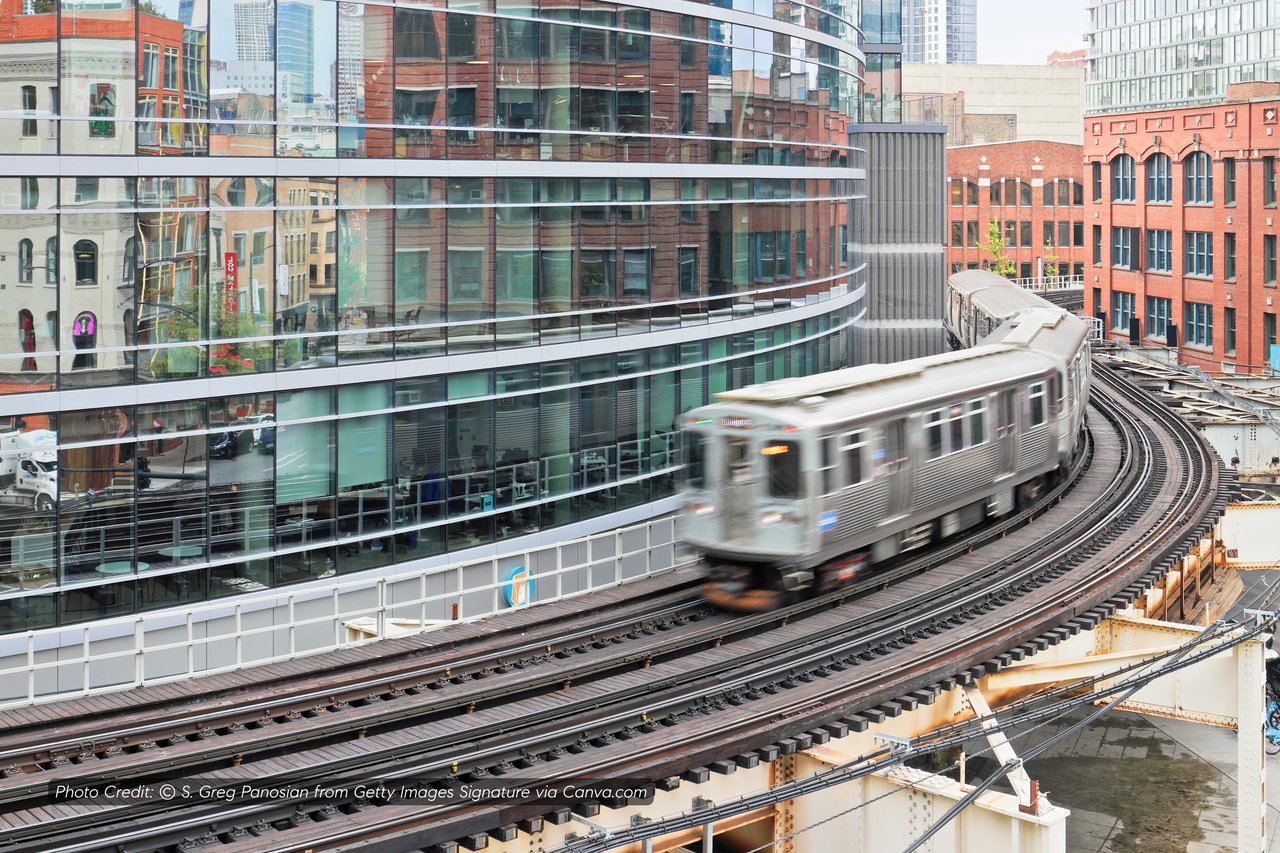
What Your Morning Commute Can Tell You About Where to Buy in Chicago
Most buyers come to me with a list of wants: the right number of bedrooms, a neighborhood they've heard good things about, and a price range they can work with. What they rarely have is a clear answer to a simpler question: how do you actually want to live each day?
The morning commute answers that question five days a week, fifty weeks a year. Chicago's citywide median sale price hit a record $411,000 in April 2026, per Illinois REALTORS® data reported by Crain's Chicago Business, while inventory fell nearly 29% year-over-year. In that market, knowing which neighborhoods to focus on — and why — matters more than it ever has. Transit access is one of the clearest filters. It is already priced in. What is less obvious is exactly how.
Key Takeaways
-
Chicago's citywide median sale price reached a record $411,000 in April 2026, per Illinois REALTORS® — rising more than five times faster than the national median that same month.
-
Inventory across Chicago fell nearly 29% year-over-year as of March 2026, per the Chicago Association of REALTORS®, making neighborhood selection more consequential than at any recent point in the cycle.
-
Lincoln Park's months of supply dropped to a record-low 0.6 MSI — the first time any North Side neighborhood has registered below 1.0 in recent history.
-
The Loop, Near North Side, and Lincoln Park offer the strongest combination of walkability and rapid rail access among Chicago's core residential neighborhoods.
-
Lakeview and Near West Side carry distinct transit profiles and different price-to-access dynamics that buyers should understand before narrowing a search.
The Loop: You're Not Buying a Commute. You're Eliminating One.
The Loop carries a Walk Score of 95. Every one of the eight CTA L lines runs through the neighborhood. Clark/Lake station alone connects six of them. Add thirty-plus bus routes and, in summer, the Chicago Water Taxi, and you have a neighborhood where a car is genuinely optional for most residents.
For buyers who work downtown, the Loop does not shorten the commute. It removes it. The tradeoff is urban density and a product mix dominated by condos — units that offer strong proximity value but do not provide the space or appreciation trajectory of single-family product further north.
According to the Chicago Metropolitan Agency for Planning's "Development Trends and Housing Affordability by Walkability in the CMAP Region" (cmap.illinois.gov), neighborhoods with the highest walkability indices in the metro consistently demonstrate stronger long-term price stability than lower-walkability counterparts. The Loop sits at the top of that spectrum. The Loop buyer in 2026 is making a conscious choice to optimize for proximity and urban convenience. The data support that choice.
Near North Side: The Neighborhood That Gives You Options
Near North Side holds a Walk Score of 96 — the third most walkable neighborhood in Chicago according to Walk Score — backed by genuine transit depth. The Brown and Purple lines stop at Chicago/Franklin Station. The Red Line extends further north through the corridor. River North and Streeterville are ten to twenty minutes on foot from the Loop, per CTA data.
What distinguishes Near North Side is that it offers multiple commute modes simultaneously at a high level: walking distance to downtown, rail access in multiple directions, and one of the densest bus networks on the North Side. Buyers here are rarely locked into a single route. Gold Coast — the premium tier of Near North Side — is defined by lakefront access, Michigan Avenue proximity, and architectural character that does not exist elsewhere in the city. The transit profile reinforces all of it.
Lincoln Park: Three Lines at One Station Is Rare. Pay Attention to It.
Fullerton Station is one of the most transit-rich intersections on Chicago's North Side. The Red, Brown, and Purple Express lines converge there — three lines at a single residential station. That density of rail access is unusual in any American city. From Fullerton, the Red Line reaches the Loop in approximately fifteen to twenty minutes per CTA schedule data.
Lincoln Park has a Walk Score of 94 and is fully built out — new detached construction enters inventory one teardown at a time, and the pipeline does not expand. That structural supply constraint is now showing up in the data in a historically significant way: Lincoln Park's months of supply fell to a record-low 0.6 MSI in early 2026 — the first time any North Side neighborhood has registered below 1.0 MSI in recent history, according to market tracking data covering Near North, Lincoln Park, Lakeview, and North Center.
What buyers frequently underestimate until they are actively searching: where you land within Lincoln Park changes your transit profile in ways that affect both daily life and price. Buyers north of Fullerton use Fullerton Station as their hub. Buyers in the southern portion of the neighborhood, near Armitage, are on the Brown and Purple lines at Armitage Station. Both are strong. But the commute time, the walk to the platform, and the surrounding price point differ — and that spread within the neighborhood is real and measurable.
What I consistently see in Lincoln Park is a buyer who has already internalized the transit geography before the search begins. They know which station they want to walk to. The three-line question isn't abstract for them — it's the reason they're looking here and not somewhere else.
Near West Side: The Commute Story That Is Still Being Priced In
Morgan Station sits at the center of Fulton Market — Green and Pink lines, positioned in the core of the district. Clinton Station is a few blocks east. For residents along Fulton Street, Randolph Street, and the surrounding blocks near Peoria and Morgan, the Loop is a ten-to-twenty-minute walk. Near West Side is one of the few neighborhoods in Chicago where residents can choose between walking downtown and taking the L based on the day's circumstances, not their address.
The commercial anchor here is among the strongest in the city. Fulton Market holds the lowest office vacancy in the entire Chicago CBD — 18.9% per Cushman & Wakefield's Q1 2026 data, against a CBD-wide average of 27.4%. Major corporate tenants have anchored the district, making it one of the most active employment corridors on the Near West Side. The product mix reflects the neighborhood's transformation: converted timber-and-brick lofts along Fulton and Randolph, newer construction condos on surrounding blocks, and a small inventory of single-family homes that command significant premiums when they appear.
Neighborhood-level pricing data for Near West Side is harder to produce cleanly than for more established residential markets — the product mix is too varied for a single median to be meaningful. What is clear is that the commercial momentum of this scale does not stay isolated from residential values indefinitely. The price-to-access ratio here remains more favorable than in neighborhoods where the full transit and employment story is already reflected in prices.
The gap between Fulton Market's commercial trajectory and its current residential pricing is something I watch closely. Neighborhoods with this profile — strong employment anchor, excellent transit, constrained residential supply — tend to close that gap. The question for buyers is whether they move before or after it does.
Lakeview: The Commute That Self-Selects for a Certain Kind of Buyer
Lakeview carries a Walk Score of 91 and solid rail coverage, but operates on a different logic than the neighborhoods to its south. The Red Line runs through Belmont, Addison, and Sheridan. The Brown Line serves Wellington, Diversey, and Paulina. Belmont is the major transfer hub for the North Side. CTA schedule data puts the Lakeview-to-Loop trip at approximately twenty-five to thirty-five minutes.
That commute time matters. Lakeview draws buyers making a deliberate trade: a somewhat longer ride in exchange for neighborhood character, school zone access, and significantly more space than is available further south at comparable prices. In Lakeview, detached and semi-detached homes in solid condition typically range from $800,000 to $1.5 million, with premium renovated properties and new construction reaching $1.8 million to $2.5 million.
Within Lakeview, transit profile splits the neighborhood in ways that affect both daily lifestyle and pricing. East Lakeview, near Sheridan and the Red Line, skews toward a younger buyer demographic and higher-density condo product. The Southport Corridor and western Lakeview, served by the Brown Line, pulls toward families, larger floor plans, and a quieter daily rhythm — with pricing dynamics that differ noticeably from the eastern portion of the neighborhood.
Lakeview buyers are typically the most clear-eyed of any group I work with. They've done the commute math, they've decided the extra minutes are worth it, and they know exactly which part of the neighborhood they want to be in. That clarity tends to make for cleaner, faster decisions once the right property appears.
What the Commute Is Really Telling You
Transit access is a proxy for something larger. It reflects a neighborhood's long-term demand profile, the financial depth of its buyer pool, and the structural limits on future supply. The neighborhoods outlined here — the Loop, Near North Side, Lincoln Park, Near West Side, and Lakeview — each have genuinely strong infrastructure. But they serve different buyers, support different lifestyles, and carry different price-to-value relationships at this moment in the market.
The commute question is often the filter that narrows a broad search to two or three serious candidates. Once that filter is applied, the work shifts to school zones, block-level pricing, and the specific inventory that is actually available. The right neighborhood is not the one with the highest transit score in the abstract. It is the one where the transit profile matches how you actually move through the city every day.
FAQ
Does living near a CTA station actually increase home value in Chicago?
Yes, and the relationship is documented. The Chicago Metropolitan Agency for Planning's "Development Trends and Housing Affordability by Walkability in the CMAP Region" identifies a consistent link between walkability, transit access, and long-term price stability across the metro. In practical terms, Chicago's citywide median reached a record $411,000 in April 2026 per Illinois REALTORS® data, while the national median grew under 1% that same month. The gap between Chicago's transit-rich core and the broader national market has been widening, not narrowing.
Which Chicago neighborhood has the best public transit access?
Near North Side carries a Walk Score of 96 and access to multiple CTA rail lines and dense bus coverage — among the most transit-accessible residential neighborhoods in the city. The Loop scores 95 and connects all eight L lines. Lincoln Park's three-line convergence at Fullerton Station is exceptional for a predominantly residential neighborhood at its price tier.
How long does it take to commute from Lincoln Park to downtown Chicago?
Per CTA schedule data, the Red Line from Fullerton Station to the Loop takes approximately fifteen to twenty minutes. The Brown and Purple lines from Armitage Station are comparable. Walk time to the platform adds a few minutes, depending on your exact location within the neighborhood.
Is Lakeview practical for downtown commuters?
For buyers who prioritize neighborhood character, school access, and space over a sub-twenty-minute commute, yes. CTA puts the Lakeview-to-Loop trip at approximately twenty-five to thirty-five minutes by rail. The question is whether that difference is material, given what Lakeview offers in return — and for the buyer profile the neighborhood consistently attracts, it typically is not.
Why is the Near West Side compelling for buyers right now?
The transit infrastructure is already in place, and the commercial momentum is documented — Fulton Market holds the lowest office vacancy in the Chicago CBD at 18.9% per Cushman & Wakefield Q1 2026. The residential pricing has not yet fully caught up to that reality. For buyers who can identify the right product type and block, that gap is the clearest structural opportunity in the city at this moment.
How should transit access factor into a Chicago neighborhood decision?
Treat it as one of three primary filters alongside school zone and price-per-square-foot relative to neighborhood median. Transit access is a daily quality-of-life variable that doesn't appear on a listing sheet but shapes every working week. Identifying the transit profile that fits your actual schedule before narrowing by other criteria tends to produce better decisions than working in reverse.
Ready to Find the Neighborhood That Fits Your Life?
If you're working through where in Chicago actually makes sense for how you live and work, I'd be glad to have that conversation. The details that determine the right block — transit access, school zones, intra-neighborhood pricing spreads — take time to map out properly. Get in touch, and let's look at the current inventory together.

Data sources: Illinois REALTORS® / Chicago Association of REALTORS® (via Crain's Chicago Business, May 2026); Cushman & Wakefield Chicago CBD Q1 2026 Marketbeat Report; Walk Score (walkscore.com); Chicago Transit Authority (transitchicago.com); Chicago Metropolitan Agency for Planning, "Development Trends and Housing Affordability by Walkability in the CMAP Region" (cmap.illinois.gov); All market data is subject to change. This post is for informational purposes only and does not constitute financial or investment advice.