Pre-War vs. New Construction in Chicago: A Buyer's Real Tradeoff
Most buyers who come to me with this question are not asking about aesthetics. They are asking about how a building holds up over 20 years, what they will actually pay every month, and whether they can sell it in a competitive market a decade from now. Chicago gives buyers more to work with on this question than nearly any American city — the pre-war inventory here is landmark-protected in ways that are not broadly understood, the co-op market is one of the most concentrated outside New York, and the luxury new construction coming online carries a financial architecture that looks simpler than it is.
Key Takeaways
Chicago's pre-war residential stock — including Astor Street District homes, East Lake Shore Drive co-ops, and vintage greystones — represents a finite, historically protected inventory that no development budget can replicate.
New construction at the luxury level carries a resale and assessment trajectory that buyers should model before committing.
Illinois condominium law does not mandate minimum reserve funding levels (765 ILCS 605) — assessment exposure in under-reserved buildings is a buyer's responsibility to evaluate, not a risk visible in the listing price.
According to Illinois REALTORS®, Chicago's citywide median sale price reached a record $411,000 in April 2026, while city inventory fell nearly 29 percent year-over-year.
The right choice depends on understanding each building's specific financial condition, not its age.
What Pre-War Actually Means in Chicago
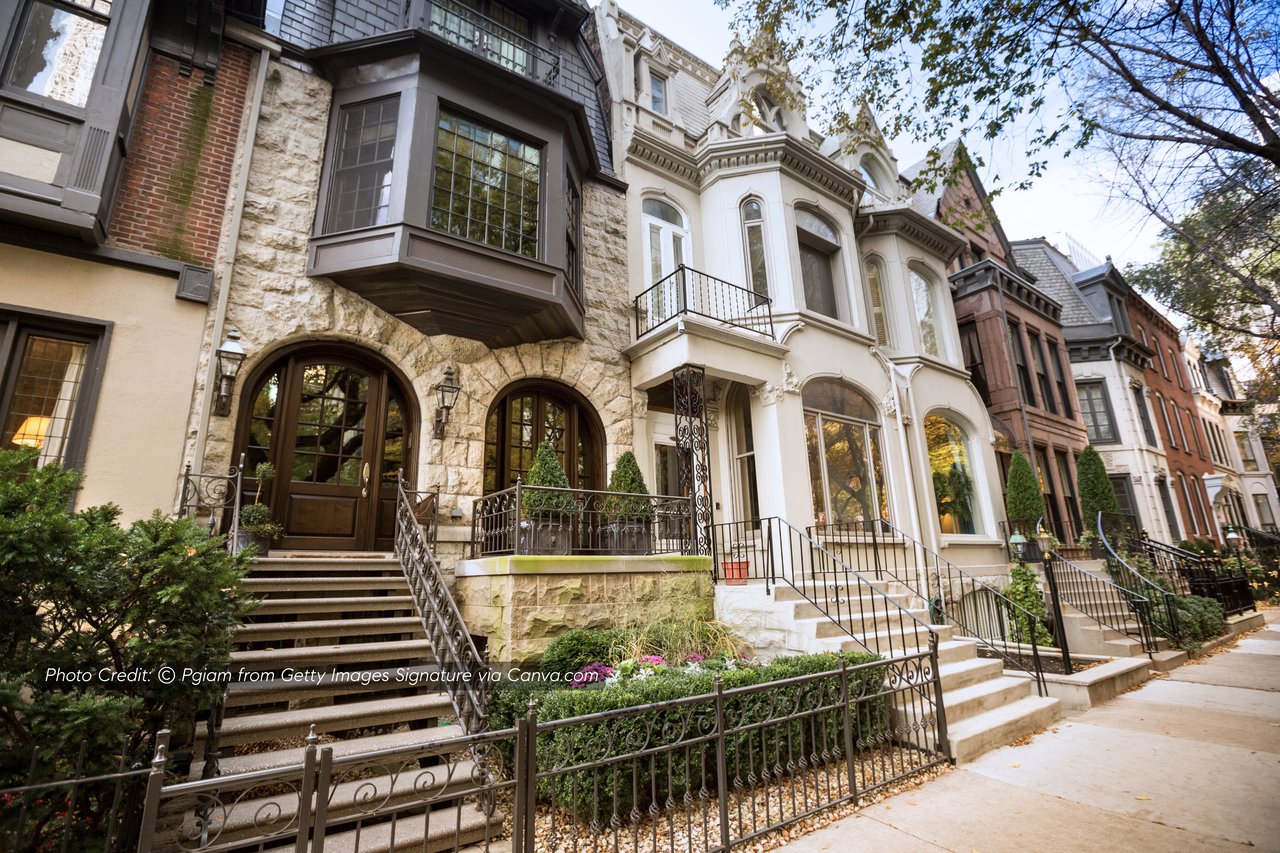
Chicago's pre-war residential stock was built primarily between the 1880s and the early 1940s. Named for the color of Indiana Bedford limestone used in their construction, Chicago greystones first appeared around 1890 as a fireproof alternative to the wood-frame buildings lost in the Great Chicago Fire of 1871. Roughly 30,000 still stand across the city today, concentrated in the "greystone belt" running through Lincoln Park, Lakeview, Hyde Park, and Woodlawn. Load-bearing masonry walls are substantially thicker than modern framed construction — audible in the quiet of a well-built pre-war building and visible in the depth of the window reveals. Ceiling heights on primary floors commonly run nine to eleven feet.
Two landmark districts define the upper tier of Chicago's pre-war residential market.
The Astor Street District — designated a Chicago Landmark on December 19, 1975, covering the 1200 to 1600 blocks of N. Astor Street — contains homes built between 1880 and 1940 in Queen Anne, Richardsonian Romanesque, and Georgian Revival styles. The landmark designation ensures that the character and density of this streetscape cannot be altered by new development.
The East Lake Shore Drive Historic District, designated a Chicago Landmark on April 18, 1985, includes the buildings at 179 through 229 E. Lake Shore Drive. Among them is the Drake Tower at 179 E. Lake Shore Drive, completed in 1929 and one of the most carefully governed cooperative residences in the city. These buildings were designed with full-floor and half-floor layouts, deep setbacks, and lake views that predate the surrounding density that would make them impossible to build today.
Gold Coast co-ops carry a different ownership structure than condominiums. The buyer acquires shares in a building corporation rather than title to a specific unit. Monthly maintenance charges are comprehensive — covering underlying building debt if any, real estate taxes, insurance, and operating costs. Co-op boards in these buildings typically restrict financing to 50 percent or less of the purchase price, and board approval is required for any purchase. For buyers who meet that threshold, the selectivity is part of the value.
New Construction: What You Are Buying and What It Costs
Post-2010 luxury new construction in Chicago — River North, the Near North Side, and the Near West Side — delivers open floor plans, floor-to-ceiling glass, technology integration, and lower near-term maintenance demands. The product is genuinely turnkey in a way that many vintage buildings require renovation investment to match.
The financial profile deserves scrutiny that the amenity list does not invite. One Chicago at 14 W Superior Street brought 77 for-sale condominiums to market with prices ranging from $1.75 million to $28 million. Developer-controlled HOA assessments during initial sales are typically set below long-term reserve requirements. Once the building transitions to resident control, assessments are recalibrated to reflect actual capital needs — buyers who commit based on the introductory figure should understand the stabilized number is likely to be higher.
The initial buyer pays for the "new" designation — first-generation finishes, never-occupied condition, the developer's pricing premium. The second buyer competes against whatever project has since entered the same tier at a comparable price point. In River North and the Near North Side, that pipeline has not been empty, and I see the compression between initial and resale pricing in that submarket consistently.
The Assessment Reality
Illinois does not mandate minimum reserve funding levels for condominium associations under the Condominium Property Act (765 ILCS 605). That absence means a building's reserve health is entirely a function of governance — and it varies widely.
In a Gold Coast co-op, every shareholder's condition affects every other shareholder, which creates institutional pressure for boards to manage reserves conservatively. That is a structural incentive the condominium format does not replicate.
In a condo building of any age, the reserve study tells the real story. Before any purchase at a serious price level, I review the reserve study, the current fund balance, the past five years of meeting minutes, and the special assessment history. Those documents surface deferred capital needs that the list price will not show.
Resale and Long-Term Value
According to Illinois REALTORS®, Chicago's citywide median sale price reached a record $411,000 in April 2026, rising more than four times faster than the national median that same month, as reported by Crain's Chicago Business. According to the Chicago Association of REALTORS®, city inventory declined nearly 29 percent year-over-year in March 2026, with months of supply across North Side neighborhoods at historically constrained levels.
Detached homes in Lincoln Park, Gold Coast, and Lakeview enter inventory through teardowns and estate sales — one property at a time. For buyers evaluating a luxury attached purchase, the question at resale is whether they are competing in the broad condo market — where new supply is always a factor — or in a narrower segment defined by architectural distinction and constrained inventory.
How This Plays Out by Neighborhood
Lincoln Park. Some of the most sought-after greystone single-family homes in Lincoln Park are found on residential blocks east of Clark Street — along streets like Orchard, Burling, and Howe — where the pre-war masonry stock defines the streetscape in a way new construction infill does not. New construction enters through teardown replacement, one site at a time. The buyer choosing a Lincoln Park greystone on one of these blocks is acquiring something the pipeline cannot reproduce. The resale analysis has to be specific to the sub-block, because pricing within Lincoln Park reflects those internal distinctions clearly.
Gold Coast and Near North Side. Astor Street District homes and East Lake Shore Drive co-ops are not simply old homes — they are a finite, landmark-protected inventory. When I walk buyers through a Gold Coast co-op for the first time, the question that surfaces quickly is not about the views or the finishes. It is about the monthly maintenance number. That number is not an HOA fee. It is a comprehensive cost of ownership that includes real estate taxes and building-level debt service, and understanding what it covers changes the comparison to new construction entirely. For buyers who understand the structure, these buildings offer something no development budget can deliver.
Lakeview. The Southport Corridor defines the detached market here, with vintage brick and greystone homes on the residential blocks between Belmont and Irving Park. The vintage masonry product on established lots in this corridor consistently holds its resale position relative to comparable new infill, and the detached segment has shown strong appreciation momentum entering 2026.
Near West Side. The pre-war inventory here is different in character — timber-and-brick loft conversions along Fulton Street and Randolph Street, not greystones. These buildings carry a specific industrial-to-residential character that new glass construction in the same corridor does not replicate. A small inventory of true single-family homes reaches this market with significant premiums when it does. The reserve and governance analysis for loft conversions here is especially important given the wide variety of building structures and HOA configurations.
What I Look For Before Making a Recommendation
When a buyer is weighing pre-war against new construction at a serious price level, I focus on four things: the building's reserve position, the board or association's governance track record, the floor plan's long-term functional utility, and the resale comparables for that specific product type in that specific location.
A pre-war co-op with a well-funded reserve and experienced board is among the most defensible luxury purchases in Chicago. A new construction condo with developer-set assessments and a shallow reserve carries risk that the finish level obscures. The analysis has to be honest about what each building's financial condition actually is — not what its age or address implies.
FAQ
Are pre-war homes in Chicago more expensive than new construction?
Not categorically. Pre-war detached homes in Lincoln Park and the Gold Coast command premiums that reflect genuine, landmark-enforced scarcity. At the luxury attached level, new construction can price higher based on amenities and first-generation designation. The meaningful comparison is building to building in the same submarket — not category to category.
What makes Gold Coast co-ops different from condominiums as a purchase?
The buyer acquires shares in a corporation rather than direct title to a unit. Monthly charges are comprehensive, covering taxes, insurance, and building operating costs. Board approval is required, and these buildings typically restrict financing to 50 percent or less of the purchase price. For buyers who meet that threshold, the structure delivers a level of financial discipline and selectivity that standard condominium ownership does not.
What is the reserve study and why does it matter?
The reserve study is an engineering assessment of a building's long-term capital needs and the funding required to meet them. Illinois condominium law (765 ILCS 605) does not mandate minimum reserve levels, which means buildings can carry shortfalls for years without legal consequence. The reserve study tells a buyer what the assessment is likely to look like five to ten years after purchase — information that is not reflected in the initial HOA figure.
Does new construction in Chicago appreciate as quickly as vintage homes?
The 2026 market data shows detached single-family homes — predominantly vintage in Chicago's established North Side neighborhoods — appreciating faster than attached product broadly. New construction high-rises face resale competition against comparable new supply entering the same submarkets. Vintage homes in landmark-protected locations do not face that same pressure at resale.
Ready to Work Through This Decision?
If you are evaluating properties across Chicago's pre-war and new construction segments, I am glad to walk through the financial and strategic picture with you. In Chicago's most competitive neighborhoods, the difference between buildings is rarely visible in the listing — and it is almost always the thing that matters most. Get in touch.

Data sources: Illinois REALTORS® / Chicago Association of REALTORS® (via Crain's Chicago Business, May 2026); City of Chicago Department of Planning and Development, Chicago Landmark designations (chicago.gov); Illinois Condominium Property Act, 765 ILCS 605. All market data is subject to change. This post is for informational purposes only and does not constitute financial or investment advice.